Identity pillar
The Imposter Syndrome: When Your Impact Outpaces Your Identity
Imposter syndrome isn't a lack of skill—it's an identity misalignment. Learn how to perform a Legacy Audit to bridge the gap between your achievements and your self-image.
I was in a conversation today with someone who is struggling with confidence in a way that they just feel like they aren’t worthy. I’ve seen it many times with many different people and have even been there myself. We have these credentials and experiences, but yet—we still feel as if we aren’t good enough. We’ve all been there. You’re sitting in a high-stakes meeting, leading a team, or closing a major deal, and a voice in the back of your head whispers: “Eventually, they’re going to realize you don’t belong here.”
Standard advice tells you to “fake it ’til you make it” or “list your achievements.” But if you’re an Architect, you know that’s just putting a fresh coat of paint on a crumbling foundation. It reminds me of putting lipstick on a pig—not a fan of that saying, but the point stands. Either way, imposter syndrome is actually a Legacy Audit issue. It is the friction caused by a misalignment between your current reality and your old Environmental DNA.
The “Borrowed Costume” Problem
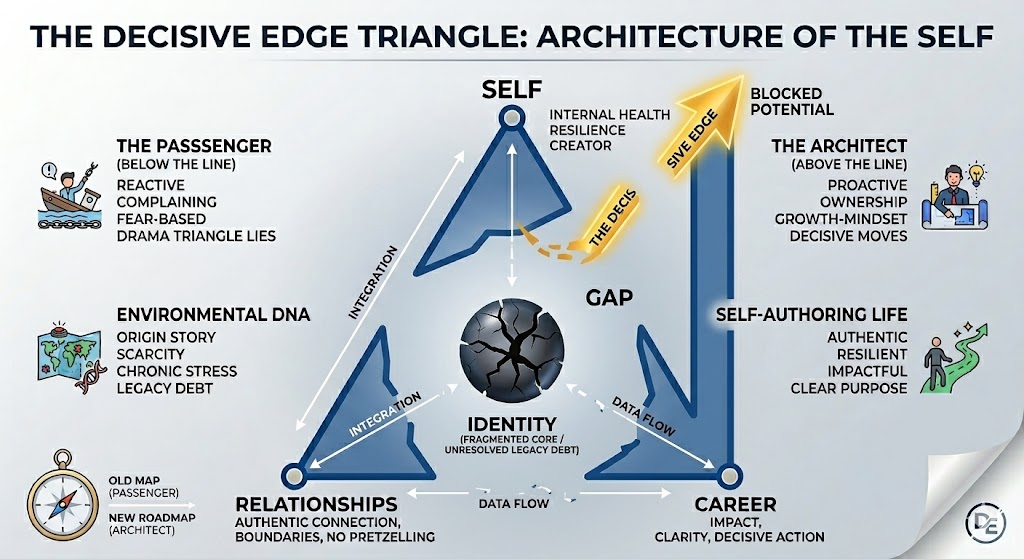
As we see in the Decisive Edge Triangle, your life is stabilized by an audited Identity Core in the center. This is the most important part of the Triangle and the whole Decisive Edge concept.
Imposter syndrome happens when you achieve success in your Career or Relationships using a version of yourself that you haven’t fully built yet. You feel like a fraud because you are—technically—wearing a costume, or at least trying it on to see if it fits. You are playing the role of a “Leader” or “Success,” but your internal Identity Core is still running the “Survival Mode” code from your origin story. That doubt can come from someone telling you that you’re not good enough, or from how others made you feel when you were establishing your core identity.
The important note is: You aren’t a fraud; you’re just under-audited. Your achievements are real, but your identity hasn’t caught up yet.
Legacy Debt: The Origin of the Doubt
Imposter syndrome often has its roots in Legacy Debt. If you grew up in a “survival” climate where love was conditional or mistakes were dangerous, your brain learned that safety equals low visibility. Now, as an adult moving “Above the Line,” your success makes you highly visible. Your old operating system sees this visibility as a threat. The “imposter” feeling is actually a survival mechanism trying to pull you back down to a “safe” (low-impact) baseline.
It’s not a lack of competence; it’s a conflict of interest between your past and your future.
The Cure: Identity Alignment, Not Confidence
You don’t beat imposter syndrome with confidence; you beat it with integration.
Stop listing achievements. Achievements are external. If your core is hollow, a million trophies won’t fill it.
Audit the “fraud” narrative. Ask yourself: Whose voice is telling me I’m a fraud? Usually, it’s a ghost from your origin story—a parent, a teacher, or a neighborhood baseline that said people “like us” don’t do things “like this.”
Own the architecture. Shift from “I got lucky” to “I designed this.” Luck is a Passenger’s excuse. Strategy is an Architect’s reality. When you take 100% ownership of the moves that got you here, the “luck” narrative dissolves.
Why This Matters
If you don’t resolve this conflict in your 20s and 30s, it turns into chronic cortisol. You will spend your entire life waiting for the “other shoe to drop.” The Decisive Edge is realizing that you don’t need permission to be in the room. You built the room.
The Decisive Edge: Imposter syndrome is just a signal that your Identity Core needs a version update.
The Audit Question
If you were 100% certain that you were the most qualified person in the room, what is the first Decisive Move you would make that you are currently stalling on?
Let’s do this!