Self pillar
The Hierarchy of Pillars: When to Prioritize What
Learn the correct sequence for a high-performance life: why the Self pillar is non-negotiable, how the Relationship pillar buffers storms, and why Career is output—not bedrock.
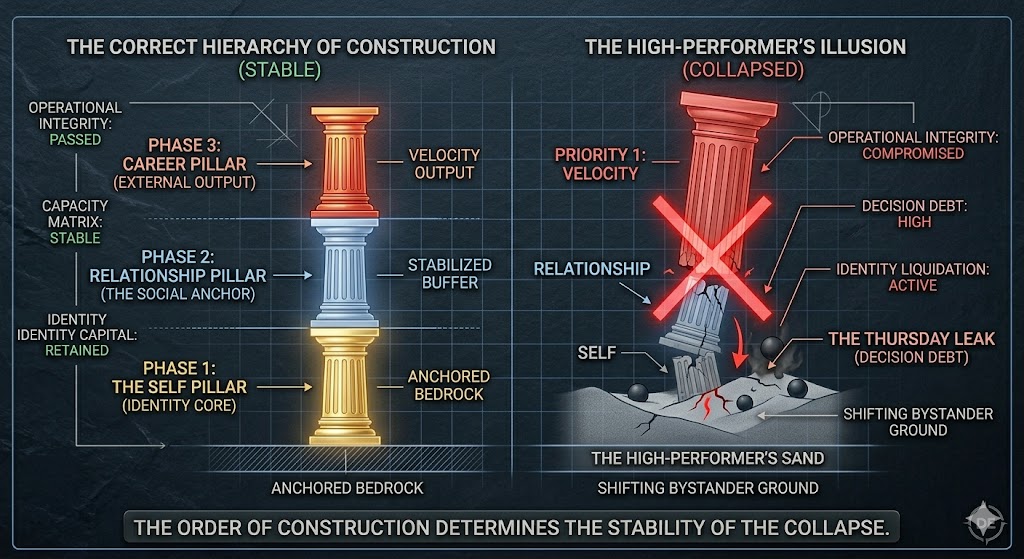
Caption: The order of construction determines the stability of the collapse.
This article answers “who’s on first”—not the skit, but which pillar is the priority and when. I’ll walk through the pillars we use in the Decisive Edge series, when each matters, why it matters, and how they work together as a system.
If you want the geometric identity of the model, start with The Decisive Edge Triangle. This piece is the sequencing and triage layer on top of that frame.
The foundation: The Self pillar (internal governance)
Priority: Constant / non-negotiable
The Self pillar is the bedrock. It is your identity core, your morning launch protocol, and your binary integrity. Here’s the line I keep coming back to—the airlines say it for oxygen masks, but it applies far beyond the cabin: put your own mask on first before you help others.
I’m not arguing for selfishness in the small sense. I’m arguing for capacity in the large one: you are best for others when you are governed, rested, and honest with yourself. You are at your best when you prioritize the basics that keep the machine true.
The rule: You never borrow from the Self pillar to pay for the other two.
The indicator: When the Self pillar is set, you feel heavy and immovable in the good way—grounded. You run a higher cognitive surplus because you are not financing every decision on credit.
The failure: Building here last. If you wait until you are “successful” to find your identity, you will have already liquidated it to get there.
More on bedrock vs. sand: The Self Pillar: Why Everything Else is Built on Sand.
The support: The Relationship pillar (the social anchor)
Priority: High / maintenance-heavy
Once the Self is anchored, you build the Relationship pillar—your invisible system: spouse or partner, inner circle, friends, family. Why second, not first?
If you aren’t your best self, how do you attract the right people to orbit you? Outside family, nobody is contractually obligated to stay. Connection has to be real. If you aren’t operating from a true self, you may be curating the wrong room—compliant relationships instead of chosen ones.
The rule: Relationships are an investment, not an expense. A strong Relationship pillar is the emotional buffer that absorbs shock when the Career pillar gets hit by weather.
The indicator: You have a sanctuary to return to. Your hearth anchor is holding.
The failure: Treating relationships as a distraction from work. A cracked Relationship pillar is a leak that eventually sinks the career anyway.
Maintenance is heavy. You have to fund time for yourself and for the people who carry you when the redline hits. That balance is hard—and it’s a core theme in the second book in the Decisive Edge series. For architecture-level relationship thinking (not vibes-only), see Intentional Relationship Architecture.
The output: The Career pillar (external velocity)
Priority: Variable / high-impact
The Career pillar is the most visible—and the most volatile. It’s where you take the storm of the workday and convert judgment into capital.
Career is last on purpose: not “unimportant,” but not bedrock. To be your best at work, you need a governed self and a stabilized inner system so you can compress effort into the windows where leverage actually lives.
The rule: Career velocity is a result of operational integrity. You don’t “grind” for success; you engineer conditions where success is the logical output.
The indicator: High leverage—output is disproportionate to effort because the system is optimized, not because you are heroic seven days a week.
The failure: Building the Career pillar first. That yields a top-heavy life that collapses when the market—or your health—shifts.
The prioritization matrix (binary triage)
When life redlines, you use this hierarchy to decide what stays and what you sacrifice temporarily. It isn’t a perfect algorithm—but it is a high-level compass. If you listen closely, your body already votes on these tradeoffs.
| Scenario | What to protect | What to sacrifice (temporarily) |
|---|---|---|
| The redline push | Self pillar (protocols) | Career (low-value tasks) |
| Family crisis | Relationship pillar | Career velocity |
| Market opportunity | Self pillar (clarity) | Social / relationship “noise” |
For the “Thursday” version of what happens when output wins over foundation, read Johnny’s Thursday: The Anatomy of a High-Performer’s Collapse.
The decisive realization
You cannot build a Career pillar that is stronger than the Self that supports it. If you are feeling the Thursday leak, it is usually because you have prioritized output (Career) over foundation (Self).
The Decisive Edge: Success is not the goal; it is the byproduct of a correctly ordered hierarchy.
The audit question
Rank your three pillars by where you actually spent energy this week. Does your real spending match the hierarchy of construction?
If Career is your biggest investment right now, ask the harder question: Is the Self pillar strong enough to hold the weight if Career load doubles tomorrow?
Was this piece useful?