Strategy & execution
Environmental DNA: Why Your Childhood Zip Code Doesn't Have to Be Your Adult Destination
Your upbringing provides the starting point, not the final destination. Learn how "Environmental DNA" shapes your brain and how to rewire your habits to break the cycle of scarcity and stress.
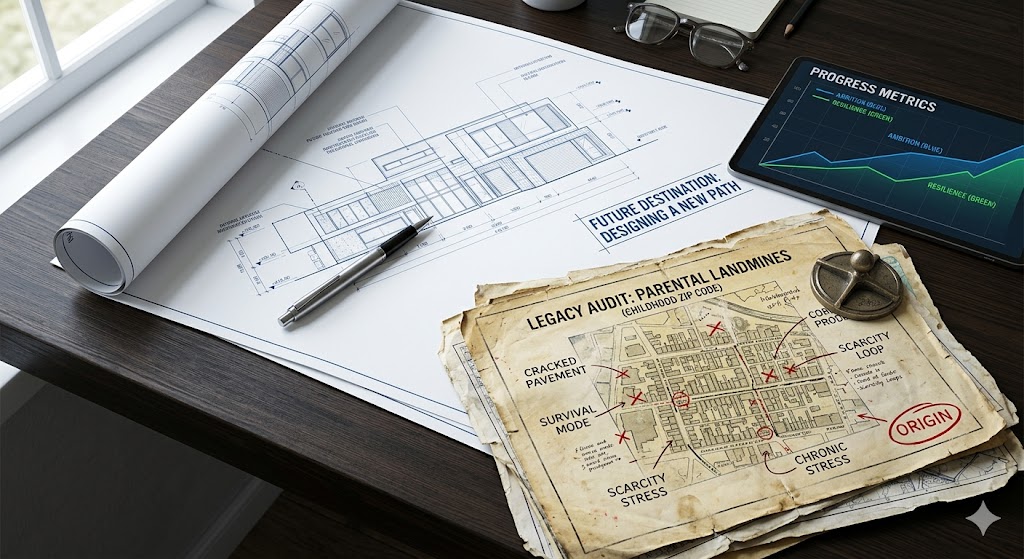
Designing a new destination by auditing the "Environmental DNA" of your past.
Ever feel like you’re stuck on a specific track because it’s "in your DNA" or part of your family legacy?
In science, Environmental DNA (eDNA) refers to genetic material collected from an environment—like water or soil—rather than directly from an organism. It’s a blueprint of what has lived in a certain space. In the context of your life, this is the psychological and social coding you absorbed just by breathing the air in your childhood home.
This includes the "ZIP Code Factor." Statistics love to tell us that the neighborhood you grew up in predicts your future income, health, and education. I’m here to tell you to ignore that nonsense. Just because you were raised in a certain area with a certain level of income doesn’t mean your future is written in stone. Your origin is a data point, not a cage. The "Environmental DNA" of your past provides the starting point, but it is not a fixed destiny.
The Decisive Edge: Just as genes can be turned on or off by lifestyle, your "social DNA" can be overwritten. You have the power to rewrite the narrative and realize that where you were raised is merely the location of the prologue, not the setting for the entire story.
The Timeline of the Turnaround
The brain is never truly "locked," but your strategy for change needs to shift based on your age.
Age 0–18 (The Imprint)
You are a sponge. If you’re in this range, turning it around means seeking mentors or safe "third spaces" (sports, libraries, clubs) outside of a toxic home.
Age 18–25 (The Final Frontier)
This is the "golden window." Your prefrontal cortex—the CEO of your brain—is finishing its development. This is the prime time to aggressively rewire your settings through new environments (like college or trade school) and radical new habits.
Age 26+ (The Reconstruction)
The brain is stable now. Change requires more effort and "intentional friction." Think of it like a path in the woods: a teenager is walking on fresh grass; an adult is trying to change a path that has been trodden down for decades. You can still do it—you just have to be more intentional about where you step.
Common "Environmental DNA" Issues & How to Defuse Them
1. The Scarcity Loop (Financial DNA)
If you grew up where resources were thin, your brain was programmed for short-term survival rather than long-term compounding. You either hoard money out of terror or blow it immediately because you don’t trust it will stay.
The Recommendation: Move from "survival math" to "opportunity math." Automate your savings. If the money is moved before you see it, you remove the "choice" to be responsible, bypassing the survival instinct entirely.
2. The Ceiling of Ambition (Social DNA)
You can’t be what you can’t see. If your neighborhood only offered examples of manual labor, your "mental map" is restricted, often leading to Imposter Syndrome on steroids.
The Recommendation: Intentionally "pollute" your environment with new examples. Join professional networks or find a mentor who lives the life you want. You need to expand the borders of your mental ZIP code until the "impossible" looks normal.
3. Chronic Cortisol (Biological DNA)
High-stress environments keep your body’s "idling speed" set to high-alert. You’re constantly looking for "the catch" even when things are peaceful.
The Recommendation: Use tactical tools to tell your nervous system the war is over. Consistent exercise and clean nutrition aren't just for looks—they are the most effective ways to lower your baseline cortisol and signal safety to your brain.
4. The Conflict Template (Relational DNA)
In tough ZIP codes, you survive by being the loudest person or the most invisible. Neither works in a boardroom or a healthy marriage.
The Recommendation: Treat communication like a foreign language. Your native tongue was "Survival," but your new life requires "Collaboration." Study books on Non-Violent Communication (NVC) to learn how to express needs without triggering a fight.
The Audit Question
Your childhood ZIP code may have left you with a higher level of grit and "street-smarts" than people from "cushy" backgrounds. That is your secret weapon. But to use it, you have to stop using your past as a crutch.
Looking at your current life, which "ZIP code habit"—Scarcity, Ambition, Stress, or Conflict—is currently keeping you from reaching your next level?
Identify it. Audit it. Rewrite it.
Let’s do this!