Self pillar
The Anchor Effect: Why a Stable Self Pillar Makes You Dangerous
Learn how a stable Self Pillar creates the ultimate advantage in negotiation. Stop being a Human Pretzel and use the Anchor Effect to dominate the room.
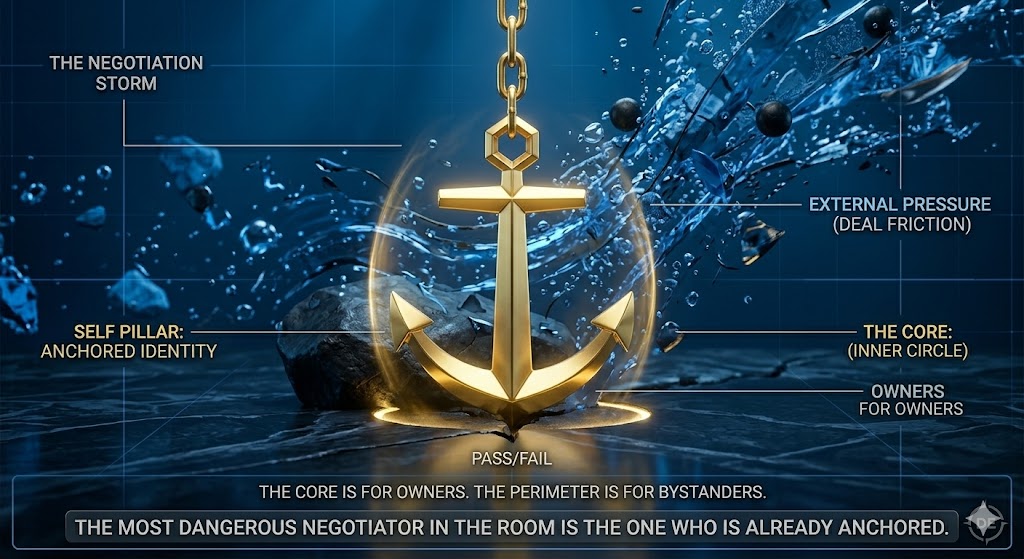
Caption: The most dangerous negotiator in the room is the one who is already anchored.
In any negotiation, the person with the most internal stability wins.
Most negotiators are Human Pretzels. They walk into the room with their identity and core already liquidated because they need the deal to feel validating. They have sanded down their edges to be likable, and the other side can smell the desperation.
The Anchor Effect occurs when your Self Pillar - your health, your protocols, and your internal Identity Core - is so immovable that the other person's pressure has nowhere to land. You become dangerous because you are the only person in the room who does not need the exit.
The physics of the frame
Negotiation is the collision of two architectures.
The bystander has a porous Self Pillar. When the other side applies pressure (a deadline, a threat, a low-ball), this person bends. They let the environment dictate their internal state and react with chronic stress.
The Decisive Leader has an anchored Self Pillar. They performed their maintenance that morning. Their body is primed, their protocols are set, and their Identity Capital is full.
When you are anchored, you do not react to a threat. You work the problem.
Why Self is the primary lever
If you have not slept, if your life is in Decision Debt, or if you have ignored your other life domains, you are entering the room with a cracked hourglass.
The other side does not have to be a better negotiator. They only have to wait for your stress level to rise and your decision quality to drop.
- Physical integrity: A leader in peak physical state carries lower reactivity and steadier executive function under pressure.
- Protocol governance: If you have already won your morning, this negotiation is a batch task, not an identity referendum.
The dangerous advantage: the power to walk
The most dangerous negotiator is the one who is perfectly comfortable with a no.
A stable Self Pillar gives you the Decisive Edge of detachment. Because your identity is not tied to this specific outcome, you can apply Binary Checks to the deal.
- Does this pass the Operational Integrity check?
- Does it align with my Capacity Matrix?
If the answer is no, you walk. A bystander cannot walk because they have no floor to stand on. An anchor cannot be moved because it is the floor.
The decisive protocol for the room
Before any high-stakes negotiation, do not review your notes first. Review your personal architecture:
- The Self-Audit: Is my Self Pillar stable? Am I hydrated, calibrated, and Above the Line?
- The Identity Anchor: Remind yourself that your value is stored in your Identity Core, not in the outcome of this conversation.
- The Binary Threshold: Set your walk-away number based on data, not the heat of the room.
The Decisive Edge: You do not get what you deserve. You get what you have the internal stability to demand.
The audit question
Think of your last loss in a negotiation. Was it because the other person had better facts, or because your Self Pillar was compromised and you prioritized ending friction over owning the result?
See also: The Human Pretzel, Strategic Recalibration vs. Self-Care, Decision Debt, and The Capacity Matrix (interactive).